
I've Taught in Rooms Where Getting It Wrong Had Consequences
When you're training military aviators, you don't have the luxury of a student falling behind and catching up later. The material has to land. The understanding has to be real. You learn quickly as an instructor that every person in that room learns differently, different pace, different prior knowledge, different way of processing information under stress.
I spent years figuring out how to reach each one of them. It was hard. It took experience, observation, and constant adjustment. And I was working with motivated adults whose lives depended on getting it right.
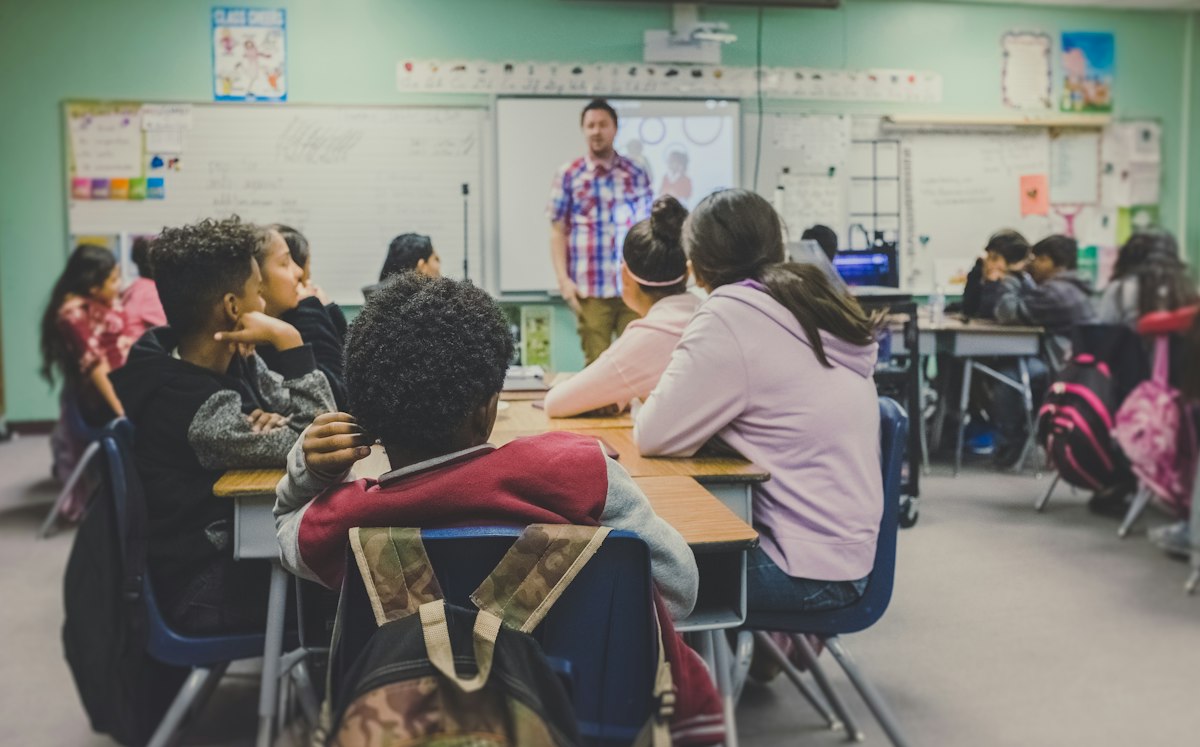
Now imagine doing that with a classroom of 30 middle schoolers, in a public school, with a curriculum mandated by a state board, and a budget that hasn't kept up with inflation in a decade. That is the reality most teachers in America face every single day.
What's happening with AI in education right now is the first time I've seen technology that could actually help with that problem at scale, not replace teachers, but give them capabilities they've never had before.
What's Actually Happening in Schools Right Now
The numbers tell a clear story. According to research from RAND Corporation published in late 2025, the use of AI tools by both teachers and students increased by more than 15 percentage points in a single year. A survey by EdWeek found that 69% of teachers said AI tools have improved their teaching methods, and 59% said AI has enabled more personalized instruction for their students.
One school district in Sumner County, Tennessee reported an 8% year-over-year increase in standardized test scores after implementing AI-assisted learning tools. That is not a marginal improvement. In education research, an 8% gain in a single year is significant.
The percentage of teachers using AI-driven tools in their classrooms nearly doubled between 2023 and 2025, according to the EdWeek Research Center. That is not a slow adoption curve. That is a rapid shift happening in real time.
What AI Is Actually Doing in the Classroom
Let me be specific, because the conversation about AI in education often stays at a level of abstraction that doesn't help anyone understand what's actually changing.
Personalized learning paths. Traditional classroom instruction moves at one pace, the pace of the lesson plan. Some students are bored because they already understand the material. Others are lost because they missed a foundational concept three weeks ago and nobody noticed. AI tutoring systems can identify exactly where each student is in their understanding and adjust the material accordingly, in real time, without the teacher having to run 30 individual assessments.
Teacher workload reduction. The average teacher spends 10–12 hours per week on administrative tasks, grading, lesson planning, progress reports, parent communications. AI tools are beginning to handle significant portions of that work. Khan Academy's Khanmigo, which became free for teachers in 2024, assists with lesson planning, generates practice problems, and provides tutoring support so teachers can focus on the parts of their job that actually require a human, building relationships, facilitating discussion, and supporting students through challenges that have nothing to do with the curriculum.
Immediate feedback loops. One of the most powerful things a great instructor does is give immediate, specific feedback. In a classroom of 30 students, that is physically impossible for most tasks. AI systems can review a student's written response, identify the specific misconception driving an incorrect answer, and provide targeted feedback within seconds, at scale, for every student, simultaneously.
Accessibility. Students with learning differences, language barriers, or gaps in prior education have historically been underserved by one-size-fits-all instruction. AI tools that can adjust reading level, provide translation, offer audio explanations, and pace instruction to the individual learner are making genuine education more accessible than it has ever been.
What's Not Working and Why It Matters
I want to be honest here, because I think the education conversation around AI tends to swing between two extremes, either AI is going to save education or AI is going to destroy it. Neither is accurate.
Sal Khan, the founder of Khan Academy, gave an interview just last week where he reflected on the limits of Khanmigo. The AI tutoring system has been impressive at delivering content, but it has struggled to motivate students who aren't already motivated. That is not a technology problem. That is a human problem. Motivation, curiosity, and the desire to learn come from relationships, from feeling seen, from having a teacher who believes in you. No AI system has solved that yet.
There are also real concerns about academic integrity. When a student can generate a passable essay in 30 seconds, the traditional essay assignment stops measuring what it was designed to measure. Schools are grappling with this right now, and there is no clean answer. The institutions that will navigate it best are the ones that redesign their assessments around what AI cannot do: original thinking, synthesis of personal experience, real-time verbal explanation, and collaborative problem-solving.
And there is a guidance gap. The RAND report noted that while AI use is increasing rapidly, formal guidance from schools and districts is lagging significantly behind. Students and teachers are figuring it out on their own, which means the outcomes are inconsistent. The schools getting the best results are the ones that have made deliberate decisions about how AI fits into their educational philosophy, not just handed students a tool and hoped for the best.
What Every Parent, Teacher, and Administrator Needs to Understand
Here is what I tell people when they ask me about AI in education: the question is not whether your students will use AI. They already are. The question is whether your school is going to help them use it well, or leave them to figure it out in ways that may not serve their actual development.
The students who will thrive in the next decade are not the ones who learned to avoid AI. They are the ones who learned to work with it effectively, who understand its capabilities and its limits, who can use it to accelerate their learning without outsourcing their thinking, and who have the foundational skills to evaluate what AI produces critically.
That requires adults who are willing to engage with the technology seriously, not dismiss it or fear it. It requires teachers who are supported in learning how to integrate these tools thoughtfully. And it requires school leaders who are willing to make decisions ahead of the curve rather than waiting until the situation forces their hand.
I have spent my career in environments that demanded constant adaptation to new technology, new threats, and new conditions. The organizations that thrived were the ones that leaned into change with discipline and intention. The ones that waited were always playing catch-up.
Education is at that inflection point right now. The classroom will never be the same. The only question is whether we shape that change or let it shape us.